A short entry on 媛

媛 hime princess; young noble lady
才媛 saien literary woman; talented woman
愛媛県 Ehime-ken Ehime prefecture
女 is woman. 爰 is the original character for 援, used to write a word meaning to pull. Older forms show that 爰 depicts hands at the upper and lower part of an object that may have been a rope or a rod¹ to convey this word to pull. 爰 is the phonetic in a range of characters. Here, through the meaning to pull in combination with 女 woman, it may (also) hint at the attraction between a man and a woman, in that way pointing to a word for beautiful (attractive) woman.² In Japanese 媛 came to mean a young woman of high social status.
Mnemonic: a princess is a woman who pulls your rope
The layout of the box above follows the style of an entry in Henshall’s 1988 book.³
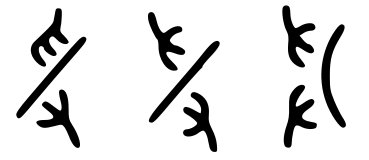
1. Oracle bone characters depict the object as a simple line. Bronze characters do likewise, but have variants among them that start a confusion of more complex objects as well. To the right impressions of oracle bone inscriptions by Ochiai (2016).
2. Xǔ Shèn has for 媛: 美女也。人所援也。从女从爰。爰,引也。That translates as: “媛 means beautiful woman, whom people [want to] pull close. It consists of 女 [woman] and 爰. 爰 means to pull/draw toward one.” Note that the direction of “to pull” in this description is different from English “attractive [woman]”, which means that the latter cannot function as a literal translation.
3. Henshall’s book doesn't have an entry on 媛.
References
- Henshall A guide to remembering Japanese characters, Kenneth G. Henshall. Tōkyō. Charles E. Tuttle Company. Rutland, Vermont & Tokyo 1990 [1988].
- Ochiai (2016) 甲骨文字辞典 (Dictionary of Oracle bone characters) 落合淳思 Ochiai Atsushi. 朋友書店 Hōyū Shoten. Kyōto, 2016.
- Xǔ Shèn 說文解字, 許慎 Xǔ Shèn . [CE 121].
First published: Tuesday 20 December 2016

CC BY-SA 4.0