Analysis and history of 求 and 裘
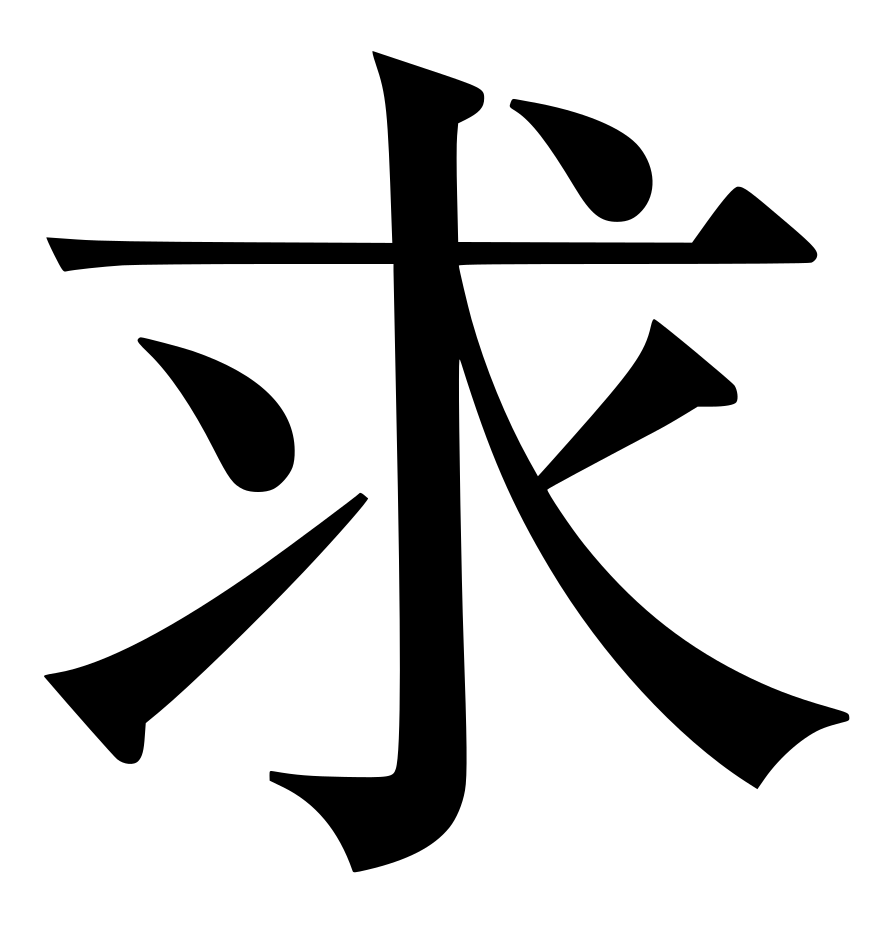
Some scholars take earlier forms like  and
and  as a plant with visible roots.¹ In this view the same plant can be seen in
 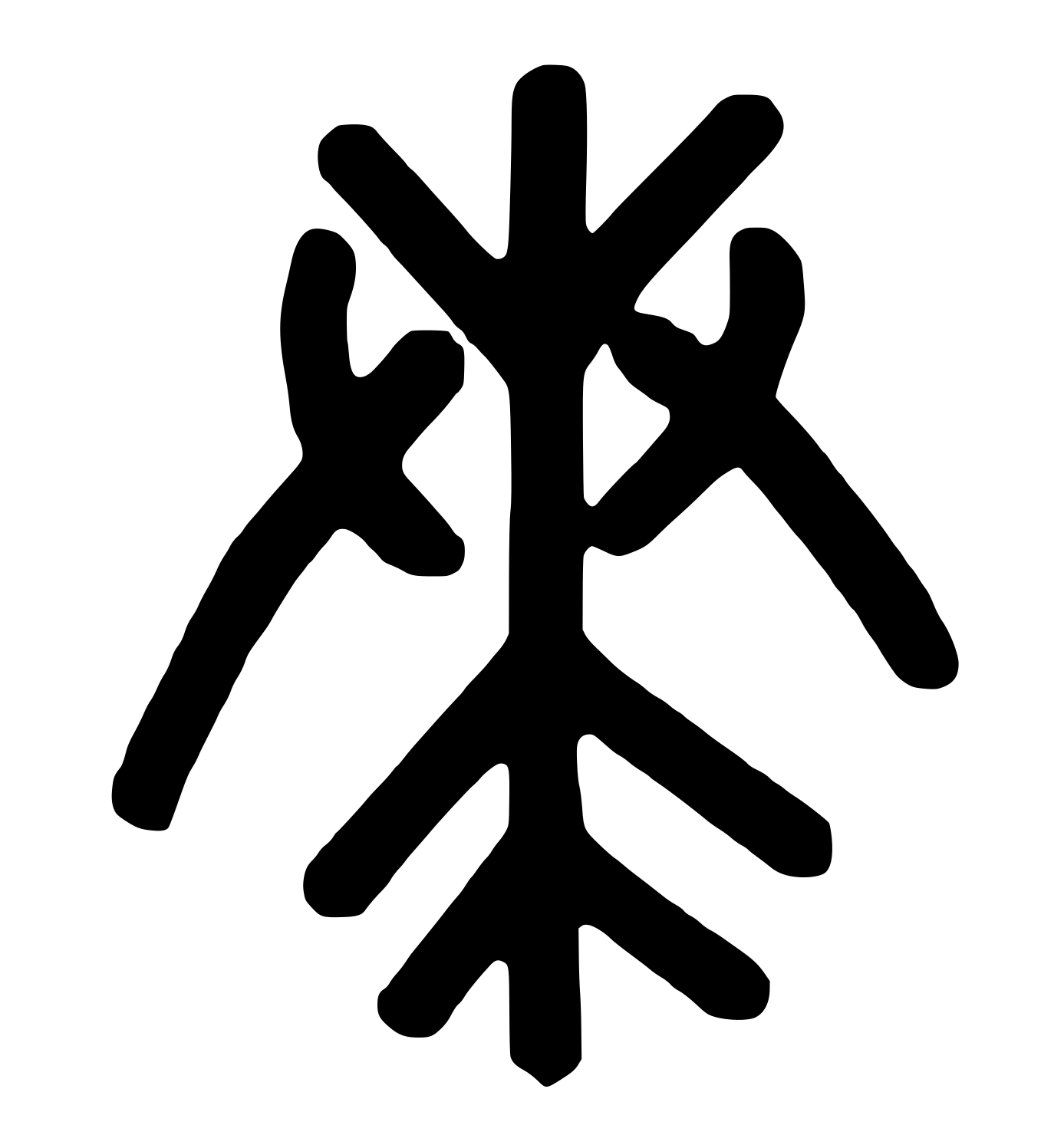 (modern 奏) which shows the plant being offered with two hands. In ancient times plants often figured in rituals, specifically rituals where favors were being asked. This allows for the interpretation that 求/ got its meaning of seek not as a direct representation (i.e. a plant), but as a symbol for the act of the ritual in which it was used: seeking help from the gods.² An alternative theory identifies the original shape of 求 as a multi-legged insect, and assumes that 求 was borrowed for its sound.³
Mnemonic: offer a plant in a request
Extended explanation and references
For a long time the standard explanation for 求 has been that it is the earlier form (protoform) of 裘 “fur clothing”. In its earliest known form it would have expressed the meaning of “fur” or “fur clothing” pictographically. In this explanation at a somewhat later stage 求 was borrowed for its sound to express the meanings “to seek for, to ask for”. More or less at the same time a new graph 裘 was created to carry the original meaning of “fur clothing” through adding the signific clothing 衣 to the original 求 for clarification.
This is a common enough scenario, but in this instance it doesn’t seem to fit, because it persuaded scholars to group together graphs that look very different. Take a look at the variant forms that Katō et al. display in their entry for 求.
| 〔契文〕 | 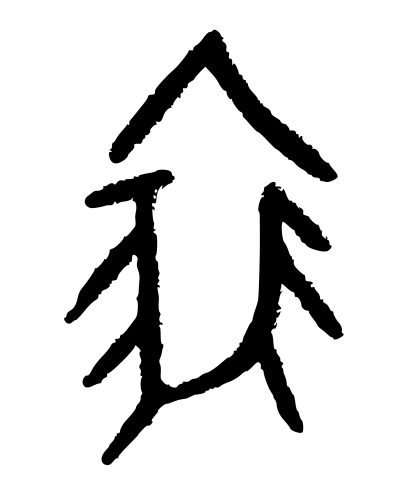 | 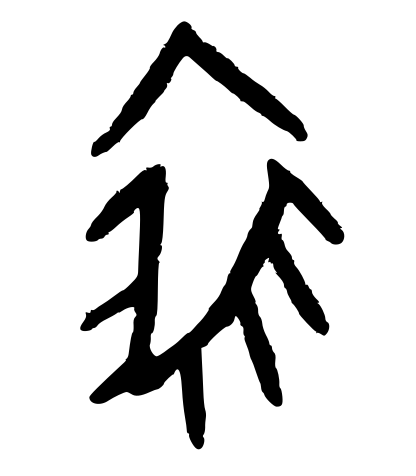 | 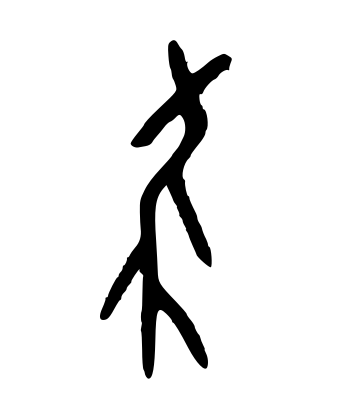 |
| 〔金文〕 | 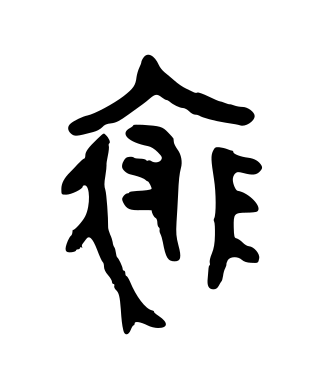 | 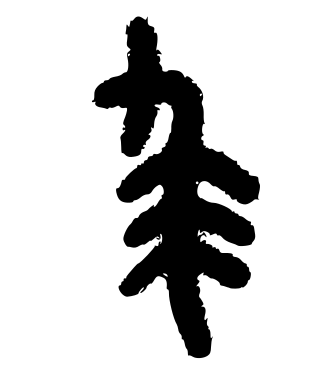 | 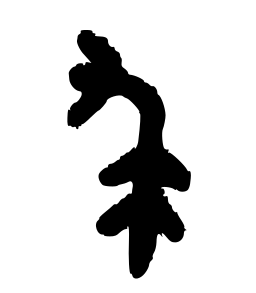 |
| 〔篆文〕 | 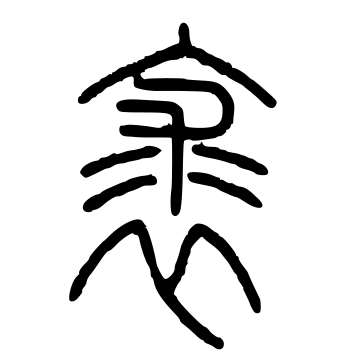 | ||
| 〔古文〕 | 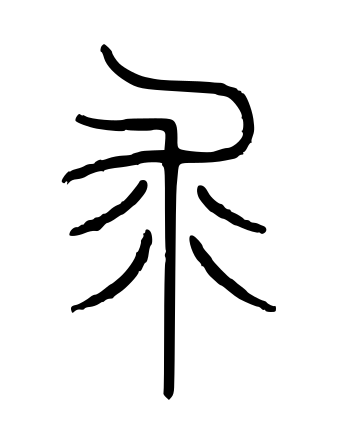 |
Katō et al. use the term 契文 keibun for 甲骨文字 kōkotsu moji (oracle bone inscriptions, short: OBI), the oldest known forms of the graphs. The first two OBI are different from the third. In the row for bronze inscriptions (金文 kinbun) the first looks like the first and the second OBI (except that a sign for hand seems to be inserted in the middle). The second and third of the bronze inscriptions look like the third OBI. Katō et al. explain these remarkable differences as alternating between “pictural representations of fur clothing” and “pictural representations of suspended fur”.¹
In the third row we see an example of a seal character. It consists of clothing 衣/ , with the seal form inserted. Xǔ Shèn 許慎 (c. 58 – c. 148 CE) analyses this graph in his famous dictionary of graphical etymology as follows:
That means that according to Xǔ Shèn the function of 求 is to add a hint for the pronunciation of 裘. Qiú Xīguī explains the entire development of 裘 from OBI to seal.
(bone)
(bronze)
(bronze)
(seal) ″裘″ qiú ″fur garment.″ The protoform of ″裘″ qiú ″fur garment″ was a pictograph; later the phonetic symbol ″又″ yòu was added. Still later the pictographic symbol that represented a fur garment was changed to the component ″衣″ yī ″clothing″ and it became an ordinary phonogram. Probably in order to accommodate a change in pronunciation, ″又″ was later changed to ″求″ qiú ″seek.″³
In other words, Qiú thinks also that 求 only comes along as a phonetic in building 裘. The OBI  (a variant of clothing with strokes added to indicate fur) was the predecessor of 裘, but not of 求. Only the odd, supposedly “suspended” variants (like and) are likely to be the predecessors of 求.
According to Ochiai scholars confused and for a specific reason. I originates in a note that Xǔ Shèn added to his entry on 裘:
求,古文省衣。 As for 求, ancient writing omits 衣.⁴
Ochiai thinks that when Xǔ Shèn stated that the ancients wrote 裘 as 求, omitting the signific 衣 of contemporary usage, this meant that 求 was used only for its sound, as a loan graph. However, other scholars may have taken this as an indication that 求 was the protoform of 裘.⁵ All things considered, I think the viewpoints of Ochiai and Qiú are more plausible.
Looking at 求/ disentangled from instances of 裘/, we can see that both OBI and bronze inscriptions of 求 look not unlike 来/來 (a representation of wheat). Ochiai thinks that 求 is actually a variant of 来/來 that emphasizes its roots. Further, looking at how 求 is used in the earliest compound characters, like for example 奏, where 求 is being offered with two hands, and another graph (no equivalent modern form, see below) where 求 is being planted in the ground, Ochiai writes that it is valid to conclude that 求 on itself was used as a symbol for the religious act in which it was being offered and/or planted.
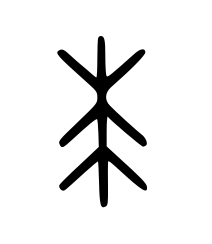
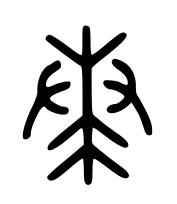
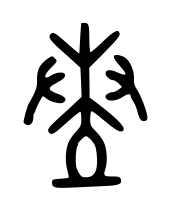
Unfortunately, while recent research seems to agree that 求 is not the protoform of 裘 but simply a phonetic that at some point came along, there might still be disagreement about which early forms in oracle bone inscriptions correspond to 求. Both MFCCD and Outlier write that OBI like  are the protoform of 求. According to this line of research, 求 originally represented a multi-legged insect, with the later meanings being loan usage.⁶
However, Ochiai identifies as the protoform of 祟.⁷
Since Ochiai uses streamlined renderings of old characters it is difficult to decide which oracle bone script characters he claims. However, it seems that bronze script characters like  are used in both theories.
In any case, there is no consensus about the early shapes and meanings of 求. Ochiai sees 求 going back to a representation of a plant being used in a ritual context that connects to its later meanings. Other scholars seem to think 求 represents a multi-legged insect en propose that the graph 求 was loaned for its sound to write an unrelated word.
Concluding remarks
The graph 来/來 (depicting wheat) was simply borrowed for its sound to convey an ancient Chinese word meaning “to come”. Some scholars think 求 was also borrowed for its sound. Ochiai thinks it depicted a plant and was used as a symbol for the expression to seek help from the gods.
Mnemonics
In its modern form 求 doesn’t look a lot like a plant any more (although it does resemble possibly related 来/來 still somewhat). Henshall creates a mnemonic by comparing 求 to 水 (water) (but adds a confusing reference to fur).⁸ For alternative mnemonics, how about:
- Holy plant demands water?
- Or (exploiting the similarity of 求 vs 来/來): We come in supplication.⁹
- Finally (not depending on other graphs, but perhaps blasphemous): To seek Jesus (a cross, arms and legs left and right, head to the right, 求).
Notes
References
- Katō et al. 角川字源辞典 (Kadokawa’s dictionary of the origin of Chinese characters) 2nd ed., 加藤常賢 Katō Tsunekata & 山田勝美 Yamada Katsumi & 進藤英幸 Shintō Hideyuki. 角川書店 Kadokawa shoten. Tōkyō, 1983.
- Henshall A guide to remembering Japanese characters, Kenneth G. Henshall. Tōkyō. Charles E. Tuttle Company. Rutland, Vermont & Tokyo 1990 [1988].
- Ochiai (2011) 甲骨文字小字典 (Small character dictionary of oracle bone characters) 落合淳思 Ochiai Atsushi. 筑摩書房 Chikuma Shobō. Tōkyō, 2011.
- Ochiai (2014) 漢字の成り立ち (The development of kanji) 落合淳思 Ochiai Atsushi. 筑摩書房 Chikuma Shobō. Tōkyō, 2014.
- Ochiai (2016) 甲骨文字辞典 (Dictionary of oracle bone characters) 落合淳思 Ochiai Atsushi. 朋友書店 Hōyū Shoten. Kyōto, 2016.
- Outlier Outlier Dictionary of Chinese Characters: Expert Edition <www.outlier-linguistics.com>
- Xǔ Shèn 說文解字, 許慎 Xǔ Shèn . [CE 121].
- MFCCD 漢語多功能字庫 <https://humanum.arts.cuhk.edu.hk/Lexis/lexi-mf/>
Modified: Wednesday 20 November 2024.

CC BY-SA 4.0